New findings in eastern Georgia's Didnauri archaeological site have reinforced the significance of the settlement for studying the ancient eastern Georgian state.
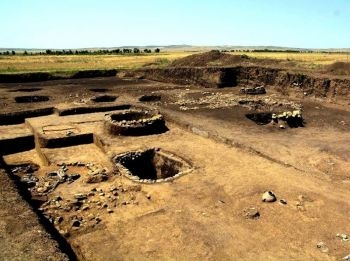
Located 150km east of capital Tbilisi, the Didnauri location stunned historians last year when it became the largest ever ancient settlement discovered in South Caucasus.
Remnants of stone, ceramic and bronze tools as well as ancient building walls dated back to the verge of the 10th and 11th Centuries BC were unearthed at the Dedoplistskaro municipality site in the Kakheti region.
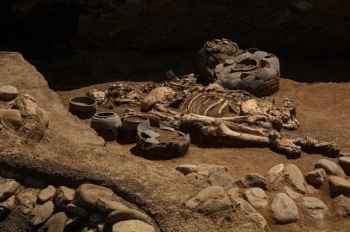
Work on the site has resulted in discovery of human remains along with various artefacts. Photo from press office of the Ministry of Culture and Monument Protection of Georgia.
Now the archaeologists involved in further work on the site have discovered a water supply system, buildings of ritual designation and artefacts in the ancient settlement area.
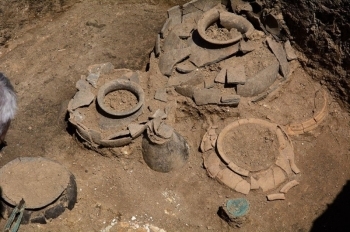
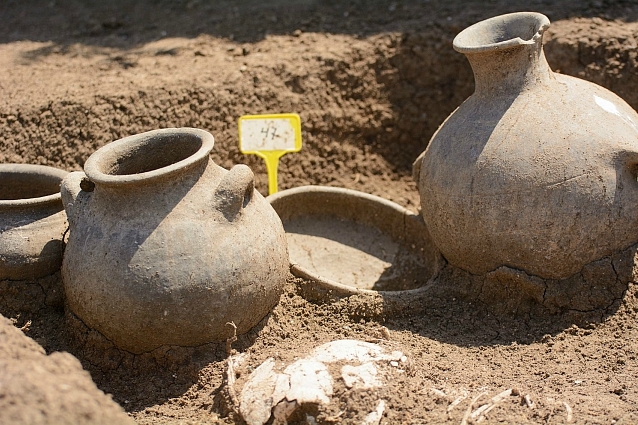
Clay vessels, stone weapons and fragments of bronze items were all found within the settlement encompassed by a 1,5km long, 7m wide wall.
In one of the most unique findings, a grave of a military commander was unearthed in the area.
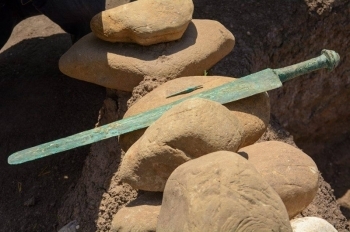
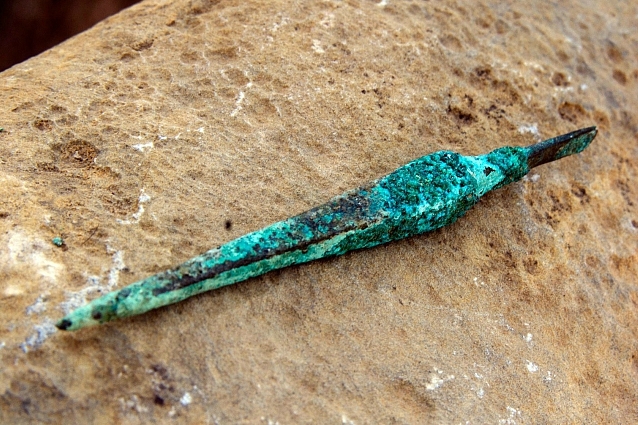
The bronze dagger found in the grave of an ancient military commander was dated back to the 13th Century BC. Photo from press office of the Ministry of Culture and Monument Protection of Georgia.
The remains of the ancient warrior featured an arrowhead in their stomach area, while a 13th Century BC bronze dagger was buried next to the individual.
History experts said the arrowhead found in the remains did not resemble those made in the Caucasus region.
Three other graves were found under an upper stone layer, while fragments of stone-built constructions were also found within the settlement wall.
Clay vessels were among the artefacts and items found in Didnauri. Photo from press office of the Ministry of Culture and Monument Protection of Georgia.
Large-scale archaeological works at Didnauri were launched last year, after the settlement was discovered as satellite photos of the area were developed by experts.
The 2015 work on the site involved mapping of the area as well as excavation and clearing of the outer perimeter of the settlement. This year the digs kicked into higher gear and focused on the area within the wall marking the boundary of the settlement.
The Ministry of Culture and Monument Protection of Georgia said further work on the site was planned for the remainder of this year.

 Frequently Asked Questions
 Sign In | Register
 GEO
GEO ENG
ENG RUS
RUS
 Forum
Forum